
Call Centre Quality Assurance Services
Scorecards weighted on resolution, three-way sampling, reviewer calibration, coaching that names the behaviour, and root-cause analysis that reports the real cause.
Page guide
On this page
Why most quality programmes fail
Almost every support operation has a quality process. Most of them measure the wrong thing, and you can usually spot it from one symptom: the scores are consistently high while customer satisfaction is not.
That happens when the scorecard measures compliance with a script rather than whether the customer's problem was solved. An agent can greet correctly, verify correctly, use the customer's name three times, follow every step, score ninety-something - and leave the customer needing to contact you again. The score is real. It is also useless.
Our starting position is that quality assurance exists to find out what is going wrong and why, not to generate a number that reassures everybody.
Building the scorecard
We design the scorecard with you rather than importing a generic one, because what counts as a good interaction is specific to your product, your customers and your risk.
Most scorecards end up with four kinds of criteria, and it matters that they are weighted differently:
- Resolution - was the problem actually solved, and would the customer agree? This carries the most weight, because everything else is in service of it.
- Accuracy - was the information correct, and was the right process followed? Errors here create rework and sometimes liability.
- Compliance - verification before disclosure, required disclosures, consent capture. Usually pass or fail rather than scored, because a partial pass on verification is a failure.
- Communication - clarity, tone, listening, whether the next step was stated plainly. Scored, but never allowed to outweigh resolution.
We also agree what an automatic fail looks like. A serious compliance breach or a factually wrong answer on something material should not be offset by a warm tone.
Sampling that tells you something
Random sampling across the whole queue tells you the average and hides the risk. We sample in three ways at once.
Random sampling establishes the baseline. Targeted sampling covers what matters most: complaints, escalations, cancellations, high-value accounts, new agents, and contact types where a mistake is expensive. Triggered sampling catches interactions flagged by signal - an unusually long call, a repeat contact within a short window, a negative satisfaction response, or a sentiment flag.
Sample volume is agreed as a proportion of contacts per agent per period rather than a flat monthly number, so a busy agent is not reviewed at the same absolute rate as a quiet one.
Calibration
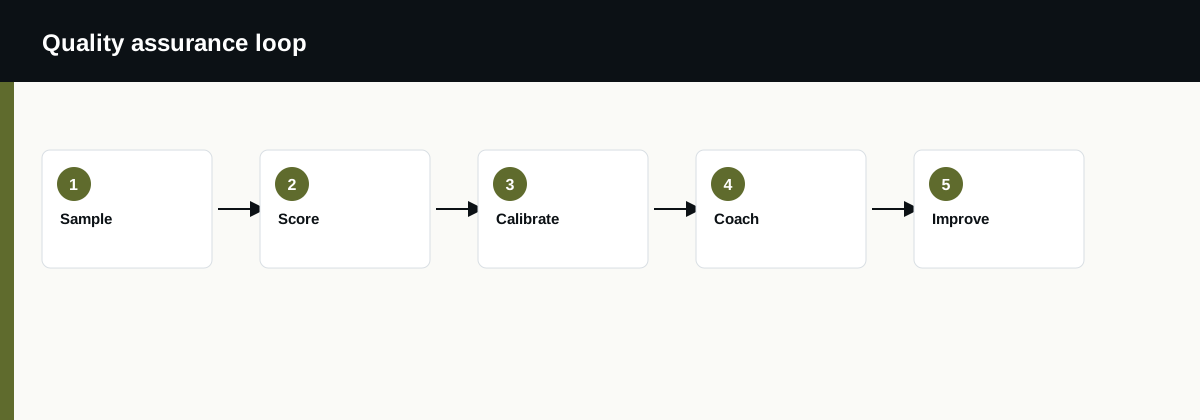
A scorecard means nothing if two reviewers grade the same interaction differently, and left alone they will. Calibration sessions put reviewers on the same interaction, compare scores and argue about the differences until the criteria are unambiguous.
We run these regularly rather than at launch only, and we track inter-reviewer variance as a metric in its own right. Rising variance means the scorecard has become ambiguous - usually because your product or policy changed and the criteria did not.
Where you want to, your own team can join calibration sessions. Clients who do usually find it the most useful hour in the reporting cycle, because it surfaces disagreements about what good service means that would otherwise stay buried.
Coaching that changes behaviour
A score delivered without a specific behaviour to change is just criticism. Coaching identifies the exact moment the interaction went wrong, what should have happened, and what to do differently next time.
Coaching is delivered by the team leader who owns the agent, not by the reviewer, so feedback comes from the person responsible for their development. Sessions are recorded against the agent so improvement can be tracked, and repeated failure on the same criterion after coaching escalates rather than repeating indefinitely.
Root cause analysis
This is where quality assurance earns its cost, and it is the part most suppliers skip.
When several agents fail the same way on the same contact type, the problem is almost never the agents. It is one of four things: a knowledge base article that is missing, wrong or unfindable; a policy that is genuinely ambiguous; a process step that does not work as documented; or a system that makes the correct action difficult.
Coaching people around a broken process is the expensive way to hide it. We report these findings as findings - including when the cause sits in your organisation rather than ours - because a client who fixes an ambiguous refund policy removes a whole category of failure permanently, which no amount of coaching achieves.
Voice of the customer
Quality scores are our assessment. Satisfaction responses are the customer's. When they disagree, the customer is the more interesting data point.
We collect post-interaction satisfaction where you want it, read the free-text comments rather than only the scores, and cross-reference low satisfaction against quality scores on the same interactions. A contact that scored well and satisfied badly is worth more analysis than ten that agreed.
What we report
Quality score by agent, team and criterion. Inter-reviewer variance. First contact resolution and repeat contact rate. Customer satisfaction, with free-text themes. Coaching activity and whether it changed the score. Root-cause findings with an owner against each.
Trends matter more than snapshots, so reporting shows movement over time rather than a single period. Where you see an illustrative dashboard on this site it is labelled as illustrative - we do not present sample data as client results. Performance figures published elsewhere on this site are historical or representative and depend on the campaign, channel mix and volume.
AI-assisted review, with human validation
Automation helps with the mechanical parts: transcribing calls, spotting whether required disclosures were made, flagging sentiment shifts, and selecting which interactions are worth a human's attention. That last one is genuinely valuable, because it raises the hit rate of a limited review budget.
A human reviewer still makes the assessment. An automated quality score that nobody has validated is a number, not a finding, and scoring agents against one is unfair as well as unsound.
Quality assurance for teams you run yourself
This is available as a standalone service. If you have an in-house team, or another supplier, and no reliable read on quality, we can design the scorecard, run the sampling and reviews, calibrate, and report - without taking over the operation.
Clients who start here often do so because they suspect a problem and cannot evidence it. An independent read settles that in weeks. See the full service range, the service levels and KPIs we report against, or talk to us about an independent quality review.
Frequently asked questions
Usually because the scorecard measures script compliance rather than whether the problem was solved. An agent can follow every step, score in the nineties, and leave the customer needing to contact you again. We weight resolution above everything else for exactly this reason.
A proportion of contacts per agent per period rather than a flat monthly number, so a busy agent is not reviewed at the same absolute rate as a quiet one. We sample randomly for the baseline, targeted at high-risk contact types, and triggered by signals such as repeat contact or a negative satisfaction score.
Reviewers scoring the same interaction and reconciling their differences until the criteria are unambiguous. Without it two reviewers grade the same call differently and the scores become meaningless. We track inter-reviewer variance as a metric in its own right.
Yes, and clients who do usually find it the most useful hour in the reporting cycle. It surfaces disagreements about what good service means that would otherwise stay buried.
AI assists with transcription, spotting whether required disclosures were made, sentiment flags and selecting which interactions deserve a human's attention. A human reviewer still makes the assessment - scoring agents against an unvalidated automated score is unfair as well as unsound.
Yes, as a standalone service. Clients often start here because they suspect a problem and cannot evidence it. We design the scorecard, run sampling and reviews, calibrate and report, without taking over the operation.