
Customer Support Technology and AI Assistance
The agent workspace, telephony, digital channels, workforce management, knowledge base, quality tooling and the specific tasks we trust automation with.
Page guide
On this page
Technology that serves the agent
Support technology is easy to buy and hard to make useful. A platform that requires an agent to hold six tabs open while a customer waits has made the job harder, not easier, whatever the feature list promised.
Our position is straightforward: the technology exists to give the agent more of their attention back, so the part of the conversation that genuinely needs a human gets one who is not rushed. Everything below is judged against that.
The agent workspace
Agents work in one place, with the customer's history from every channel visible. That is the entire point of an omnichannel workspace - a customer who sent a WhatsApp message on Monday and rings on Wednesday should not have to explain it again.
Wherever possible, that workspace is yours. Agents use your CRM, help desk and telephony rather than a parallel system, because a second copy of your customer data in someone else's platform is a liability you inherit and a synchronisation problem you pay for twice.
Platforms our teams work in
These are systems our agents are competent in and have been trained on. They are compatible platforms, not partnerships, endorsements or certifications, and we will not describe them as such.
- Help desk and ticketing: Zendesk, Freshdesk, Zoho Desk, Intercom, Gorgias.
- CRM: Salesforce, HubSpot.
- Commerce: Shopify, WooCommerce, Adobe Commerce, Amazon Seller Central.
- Productivity and collaboration: Microsoft 365, Google Workspace.
- Telephony: common cloud contact-centre and VoIP platforms.
- Messaging: WhatsApp Business, live chat widgets, the major social platforms' business inboxes.
If you use something not listed, that is usually a training question rather than a blocker. Tell us early, because system access is reliably the slowest step in going live and it almost always sits on the client side.
Telephony, routing and IVR
Calls arrive against a queue and a skill group, with menus kept deliberately shallow. Every extra menu layer loses callers, and a caller who abandons a menu rings back less patient than before.
Callback handling matters as much as queueing. Where a promise is made on a call, the follow-up is scheduled and owned rather than left to memory. Recording, where you use it, is configured to your requirements and to what the law in your market allows - recording rules differ by country and are not ours to assume.
Digital channels
Chat is a concurrency problem: how many conversations one agent can hold before quality degrades. That number is set per account and per complexity, and it is lower than most platform defaults suggest.
Email and ticketing is a triage problem. Queues sorted by intent and urgency resolve faster than queues answered in arrival order, and intent classification is one of the places automation genuinely earns its place. WhatsApp is a primary support channel in several of our markets rather than a secondary one, and it operates within its own consent and template rules. Social media support answers publicly where that helps other customers, and moves to a private thread the moment personal details appear.
Workforce management and scheduling
Forecasting from arrival patterns, rostering against shift units, and intraday adjustment when the forecast is wrong. This is where coverage decisions become real: it is common to find that the quickest available improvement is not more agents but the same agents rostered differently.
Knowledge base
The knowledge base is the highest-leverage system in a support operation and the most neglected. An article that is out of date does more damage than a missing one, because the agent trusts it.
We treat knowledge gaps as quality findings. When several agents fail the same way on the same contact type, the fix is usually an article rather than coaching, and our quality reporting is designed to tell those two cases apart.
Quality assurance tooling
Interaction sampling, scorecards, calibration between reviewers, coaching records and trend reporting. Where AI assists in selecting which interactions to review or in flagging likely issues, a human reviewer still makes the assessment - an automated quality score nobody has validated is a number, not a finding.
Dashboards and reporting
Standard reporting covers first contact resolution, customer satisfaction, speed of answer, abandonment, handling time and response times, broken down by channel, queue and shift.
Where you see an illustrative dashboard on this site, it is labelled as illustrative. We do not present sample data as client results.
Where AI helps
Specific, bounded tasks where the cost of being wrong is low and a human checks the output:
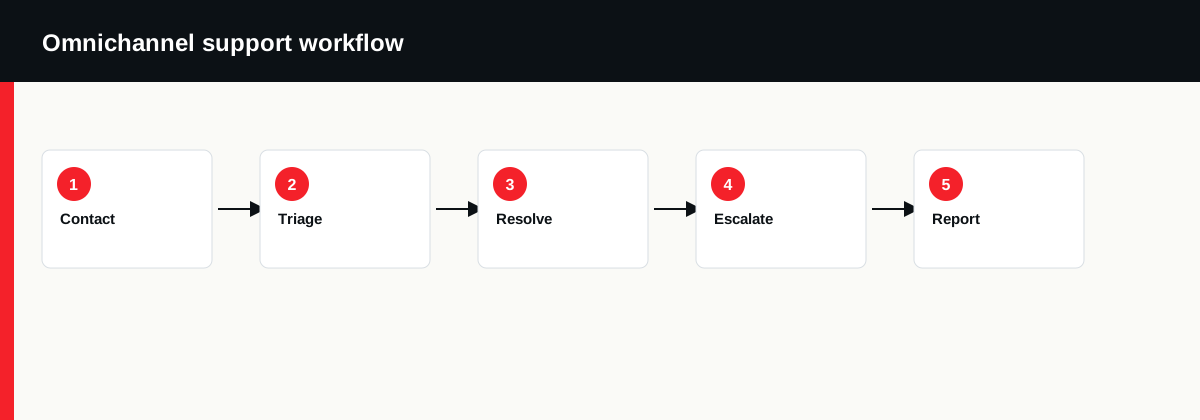
- Summarising a long conversation before it is escalated, so the next tier does not start from zero.
- Classifying inbound email and chat by intent, to route it properly.
- Surfacing the relevant knowledge article while the agent is still typing.
- Drafting a first reply for a human to review, edit and send.
- Sentiment and intent signals to flag interactions worth a quality review.
A person remains responsible for judgement, tone, exceptions and anything involving money, complaints or vulnerability. We are sceptical of automated deflection as a headline strategy: it reduces contact counts and can raise costs, because the contacts it fails to deflect arrive later, angrier and harder to resolve. Removing the typing while keeping the judgement is the trade that holds up.
Security and access
Access is least-privilege and role-based, granted per agent and revoked when it is no longer needed. Agents are trained on verification before disclosure. Where you require specific controls - restricted environments, no local storage, particular retention settings - those are configured as part of scoping rather than discovered afterwards.
RH International Ltd. is registered with the Information Commissioner's Office under reference ZB879055. We will walk your security team through our controls in detail, and we do not claim certifications we do not hold.
Next steps
See the services this technology supports, read how it works in practice on phone support, or tell us what systems you run and we will tell you honestly how much integration work sits in front of a productive agent.
Frequently asked questions
Yours, wherever possible. A second copy of your customer data in someone else's platform is a liability you inherit and a synchronisation problem you pay for twice.
No. They are platforms our teams are trained and competent in. We do not hold or claim partnerships, endorsements or certifications with them, and we will not describe them that way.
Usually a training question rather than a blocker. Tell us early, because system access is reliably the slowest step in going live, and it almost always sits on the client side.
No. Automation handles summarising, classifying, surfacing knowledge and drafting replies for a human to check. A person stays responsible for judgement, tone, exceptions and anything involving money, complaints or vulnerability.
Because it reduces contact counts without always reducing cost. The contacts it fails to deflect arrive later, angrier and harder to resolve. Removing the typing while keeping the human judgement is the trade that holds up.
Only where you require it, configured to your retention settings and to what the law in your market allows. Recording rules differ by country and are not ours to assume.