
Human-Led, AI-Enhanced Customer Support That Scales With Your Business
Build a dedicated multilingual customer service team from five FTEs across phone, chat, email, WhatsApp and social media - with flexible coverage, measurable quality and technology that helps people respond faster.


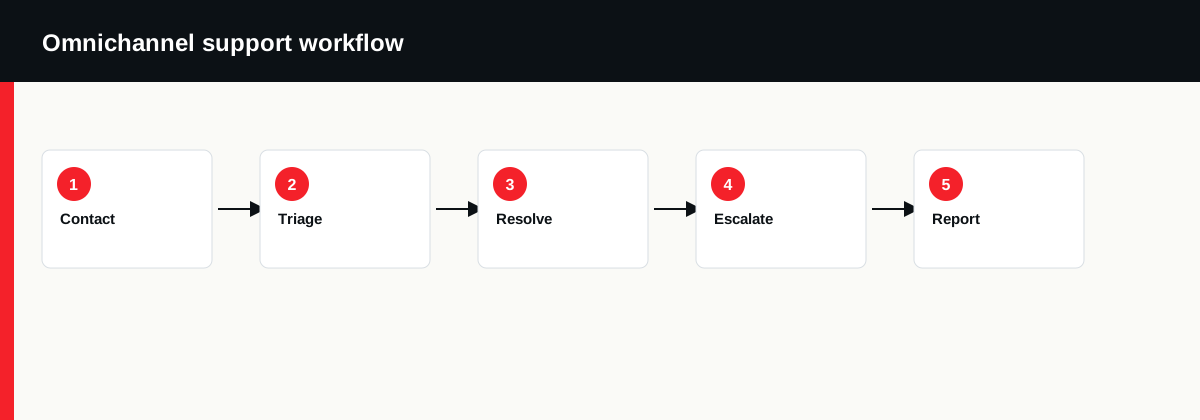
Operations at a glance
One trained team across the channels customers actually use
- Phone, chat, email, WhatsApp and social contact move through one operating rhythm.
- Quality reviews and escalation rules keep service consistent as the team grows.
- Reporting highlights volume, response patterns and improvement opportunities.
By the numbers
20+
Years
Historical
Cumulative since founding
550+
Employees
Current
Approximate figure
650
Operational Seats
Current
Scalable configuration
1,500 seats
Scalable to
Potential
With infrastructure investment
1,800+
Campaigns
Historical
Cumulative delivery history
375+
Clients
Historical
Verified client engagements
4 years
Average client tenure
Historical
Based on active/past clients
Within one ring
Speed of answer
Typical
Campaign and traffic dependent
Brands we have supported
















Brand names and logos are trademarks of their respective owners. Their display reflects past service experience and does not necessarily imply a current relationship or endorsement.
Customer support outsourcing, explained simply
Outsourcing your customer support means someone else hires, trains and manages the people who answer your customers - while you keep control of how those customers are treated. RH International Ltd. builds that team for you. You tell us the channels your customers use, the hours you need covered and the standard you expect. We recruit for it, train for it, measure it and report on it.
What you get is not a shared pool of agents juggling ten brands at once. You get named, dedicated, full-time people who learn your product, use your systems and sit in your queue. They work only on your account. Over time they stop sounding like an outsourcer and start sounding like your own team, because in every practical sense that is what they are.
That distinction matters more than any feature list. A shared agent handling six accounts cannot hold your refund policy in their head. A dedicated agent can, and the difference shows up in resolution rates, in repeat contacts and in what your customers say about you afterwards.
Start with five people, not a five-year commitment
Our minimum deployment is five full-time agents. That is deliberately small. It is enough to cover a real shift pattern with proper handover, holiday cover and someone to escalate to - and small enough that you can find out whether outsourcing works for you without betting the year on it.
From there you scale in the direction the data points. Most teams grow one of three ways: more agents on the same channel because volume is rising, the same agents across more channels because customers are moving to chat and WhatsApp, or more hours because your customers are contacting you at times nobody is currently working. You do not have to pick the right answer in advance. You have to be able to change your mind cheaply, and a dedicated-team model lets you.
Use the team builder further down this page to sketch a shape and see what it involves. Nothing you enter is a commitment, and no figure it returns is a formal quote.
One customer, every channel
Your customers do not think in channels. They send a WhatsApp message on Monday, reply to an email on Tuesday and ring you on Wednesday about the same problem - and they expect whoever picks up to already know. Omnichannel support means the history travels with the customer instead of resetting at every door.
We staff and run these channels:
- Phone - inbound queues, callbacks and outbound follow-up. Read how we run live phone support outsourcing in detail.
- Live chat - agents handling several conversations at once, with concurrency set so quality does not fall over at peak.
- Email and tickets - sorted by intent and urgency rather than answered in the order they landed.
- WhatsApp - the default channel in several of our markets, run within the consent and template rules that apply to it.
- Social media - public comments answered publicly where that helps other customers, and moved to a private thread the moment personal details are involved.
Whichever channels you start with, the same team can pick up the next one. That is usually cheaper and always faster than standing up a second supplier, and it means a customer who switches channel mid-problem does not have to start again.
Cover the hours your customers actually contact you
Most support operations are staffed around the working day of the head office rather than the behaviour of the customer. Look at when your contacts genuinely arrive and there is often a clear evening or weekend peak that nobody is rostered for.
Coverage is built from shift units, so it is easy to reason about. A standard eight-hour day is one unit. Twelve-hour cover is two. Weekends need enhanced staffing. Round-the-clock cover is three daily teams plus a weekend and holiday plan. Those rules are configurable rather than fixed, because a retailer in November and a software company in August have very different weeks.
Start with the coverage your customers need today and extend it as demand grows. Evening, weekend, holiday, overflow and round-the-clock schedules can be added through a staffing plan designed around your actual service window - not bolted on as an emergency when a queue collapses.
How quality stays measurable
"Good service" is not a measurement. Without a scorecard, quality becomes whatever the loudest complaint says it is this week. We audit real interactions against a written standard agreed with you, and we publish what we find whether it flatters us or not.
In practice that means sampled calls, chats and emails reviewed against your scorecard; calibration sessions so two reviewers score the same interaction the same way; coaching aimed at the specific behaviour that lost the point; and root-cause analysis when the same failure keeps appearing. Very often the answer is not agent performance at all - it is a knowledge-base gap, a confusing policy or a broken step in your own process. Those findings are worth more than the score.
We report on first contact resolution, customer satisfaction, speed of answer, abandonment and response times by channel. Figures shown elsewhere on this site are historical or representative and depend heavily on the campaign, the channel mix and the volume. They describe what our teams have achieved on particular accounts. They are not a promise about yours, and any supplier who offers you their numbers as a promise before seeing your queue is selling rather than planning.
Where AI helps, and where people decide
We use automation where it removes work that nobody should be doing by hand: summarising a long conversation before it is escalated, classifying incoming email by intent, surfacing the right knowledge-base article while the agent is still typing, drafting a first reply for a human to check, and flagging interactions worth a quality review.
We do not hand the customer to a machine and hope. A person stays responsible for judgement, for tone, for exceptions and for anything involving money, complaints or vulnerability. The point of the technology is to give the agent more of their attention back, so the part that genuinely needs a human gets one who is not rushed.
This is a deliberate position, not caution about tooling. Automated deflection reduces contacts and can raise costs, because the contacts it fails to deflect arrive later, angrier and harder to resolve. Removing the typing while keeping the judgement is the trade that holds up.
Multilingual teams, and where they can reach
Our India operation staffs Hindi, Hindi-English bilingual, English, Bengali, Nepali and Punjabi support as a standing capability. Marathi, Gujarati, Tamil, Telugu, Kannada, Malayalam, Assamese and Odia are available on request, subject to a recruitment lead time. See how we staff and quality-check each language, or read about Hindi customer support as a worked example.
For international voice work we staff neutral international English. UK onshore and nearshore agents are available where a customer base genuinely needs them - for regulated conversations, for accent expectations, or because a specific contract requires it. We do not claim onshore delivery anywhere else, and we would rather tell you that up front than discover it during a pilot.
We support organisations selling into India, the United States, Canada, the United Kingdom, Australia, New Zealand, the UAE, France, Italy and the Philippines. That is a list of markets our teams serve, not a list of offices we keep or languages we speak locally. If you need French or Italian language support rather than English support for those markets, say so early and we will tell you honestly whether we can staff it.
Getting your team live
A support team that goes live badly takes months to recover. The sequence we follow is deliberately unglamorous.
- Scope. Channels, languages, volumes, hours, systems, and what "resolved" means for each contact type.
- Design. Team shape, shift pattern, escalation path, and who on your side owns decisions.
- Recruit. Hiring against the profile the work actually needs, including language and register.
- Train. Your product, your systems, your tone, your policies - then assessment before anyone takes a live contact.
- Pilot. A limited live window with tight review, so problems surface while they are still cheap.
- Stabilise. Scorecards running, reporting agreed, coaching cycle in place.
- Scale. Add hours, channels or headcount against evidence rather than optimism.
Timelines depend on language, complexity and how quickly system access can be arranged. Access is usually the bottleneck, and it is usually on the client side, so it is worth starting early.
What it costs, and what changes the number
Pricing is published per dedicated agent per month, by market and language, with a five-agent minimum. Every published figure is a starting point for planning rather than a quote, and it always carries the basis it is calculated on.
The things that move the real number are predictable: which channels you need, which language, how complex the process is, how long training takes, how many hours you want covered, what technology sits in the way, how much volume arrives, what service levels you want held to, and where the team is delivered from. A supplier who quotes a firm price before knowing those things is guessing, and the guess will be corrected later at your expense.
Why organisations choose RHI
Because the team is dedicated and yours. Because five agents is a small enough first step to be a real test. Because coverage extends when your customers change their habits rather than when a contract renews. Because quality is written down, sampled and reported instead of asserted. Because multilingual India delivery and an onshore UK option can sit in the same plan. And because we would rather tell you what we cannot do before you sign than explain it afterwards.
See the full range of customer support and BPO services, or use the service explorer if you would rather start from the problem than the service name.
What we run for you
Customer Care Outsourcing
A dedicated team owning the whole customer relationship across every channel, with a written authority…
Customer Care OutsourcingPhone Support
Dedicated full-time agents handling inbound calls, callbacks and outbound follow-up, rostered around when…
Phone SupportInbound Call Centre
Dedicated inbound teams sized from your interval-level arrival data, with occupancy and shrinkage assumptions…
Inbound Call CentreOutbound Callback and Follow-up
Requested callbacks, missed call returns, promise follow-up and resolution confirmation. Customer service…
Outbound Callback and Follow-upLive Chat Support
Dedicated chat agents with concurrency set for your traffic and complexity, not for a platform default.
Live Chat SupportEmail and Ticket Support
Dedicated agents working a queue triaged by intent, urgency and complexity, with named ownership so nothing…
Email and Ticket SupportWhatsApp Support
Dedicated agents handling WhatsApp support within the platform rules: service window, approved templates…
WhatsApp SupportSocial Media Support
Support with an audience: acknowledge publicly, resolve privately, and escalate reputational risk to a named…
Social Media SupportOmnichannel Customer Support
One dedicated team across phone, chat, email, WhatsApp and social, with the customer history travelling with…
Omnichannel Customer SupportLanguages we staff
Markets we support
Sectors we work in
Service Explorer
Build Your Support Team
Frequently asked questions
RHI plans dedicated full-time teams from a minimum of five FTEs. Final staffing depends on channels, languages, service window, volume and process complexity.
Round-the-clock schedules can be planned using dedicated staffing. 24/7 coverage is configured around the actual service window, weekends, holidays and overflow needs.