
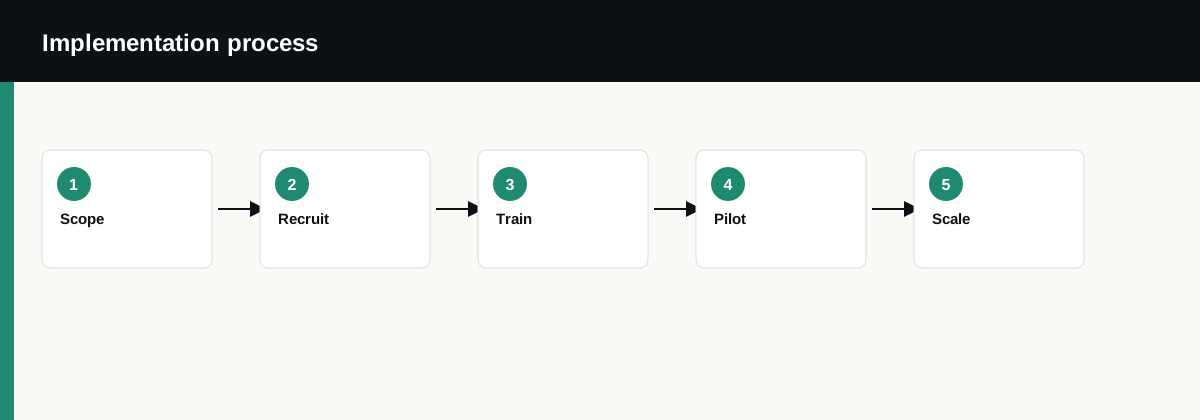
How to Outsource Customer Support: Our Implementation Process
Scope, design, recruit, train, pilot, stabilise, scale - and the three things that actually determine your timeline.
Page guide
On this page
Getting this wrong is expensive
A support team that launches badly takes months to recover, because the damage compounds: agents learn wrong answers, customers form an opinion, and the reporting that would show you the problem is not running yet.
The sequence below is deliberately unglamorous. It is also the part of an outsourcing arrangement where most of the risk actually sits - not in the contract, and not in the technology.
1. Scope
Before anything else, we write down what the team will and will not do. Channels, languages, volumes, hours, systems, and - the one most often left vague - what "resolved" means for each contact type.
That last point matters because it determines the authority boundary. An agent who does not know whether they can approve a refund will either escalate everything, which makes them a switchboard, or guess, which is worse. We agree the boundary per contact type and write it into training and the scorecard.
We also agree what is explicitly out of scope, so it escalates rather than being improvised.
2. Design
Team shape, shift pattern, escalation path and reporting. Who on your side owns decisions, and who we contact out of hours.
Coverage is designed against your arrival data rather than your office hours. This is where clients are most often surprised: the shift pattern that matches customer behaviour frequently differs from the one they assumed, and the least expensive improvement is sometimes rostering rather than headcount.
For omnichannel accounts the intent taxonomy and reason codes are agreed here, across all channels at once. Harmonising them later is far more work than agreeing them now.
3. Recruit
We hire against the profile the work actually needs, including language and register. Voice roles are assessed on live-style call simulations; written support is assessed separately, because reading a language and holding a difficult conversation in it are different skills.
Recruitment lead time depends on the language and the complexity. A larger recruitment pool fills faster. Where you need a specific register or a less commonly staffed language, that is the constraint on your go-live date and we will say so at scoping rather than discovering it later.
4. Train
Your product, your systems, your tone of voice, your policies, your escalation rules - then assessment. Nobody takes a live contact before passing.
Training material is built from your documentation, and building it reliably exposes gaps in that documentation. Those gaps are worth knowing about: a process nobody can write down clearly is one your own staff are probably improvising too. We report what we find rather than quietly filling in the blanks with assumptions.
5. Pilot
A limited live window with tight review. Lower volume, a narrower contact set, and every interaction reviewed rather than sampled.
This is the most valuable stage and the one clients most often want to compress. The purpose is not to prove the team works - it is to find the things nobody anticipated while fixing them is still inexpensive. Typical pilot findings: a contact type absent from the scope, a system permission nobody granted, an escalation route that dead-ends, a policy that two people in your organisation interpret differently.
Compressing the pilot does not remove those problems. It relocates them to full volume.
6. Stabilise
Scorecards running, sampling at agreed volume, calibration underway, reporting flowing, coaching cycle established. Service level targets move from modelled to measured, and get confirmed or revised against what the live data shows.
We would rather revise a target here, with evidence, than carry an aspirational number that gets missed every month.
7. Scale
Add hours, channels or headcount against evidence. Growth usually goes one of three ways: more agents on the same channel because volume is rising, the same agents across more channels because customers are moving to chat and WhatsApp, or extended hours because contacts arrive when nobody is working.
You do not have to predict which. Adding a channel to an existing trained team is much faster than the original launch, because the design work is already done.
What determines the timeline
Three things, in order of how often they are the binding constraint:
- System access. Reliably the slowest step, and it almost always sits on the client side. Security review, supplier onboarding and licence provisioning take longer than anyone plans for. Start it at scoping, not at training.
- Recruitment. Driven by language, register and the seniority the work needs.
- Training length. Driven by product and process complexity, and by how good your existing documentation is.
We give an indicative timeline at scoping with the assumptions visible, so you can see which of those three is driving it and whether you can influence any of them. We do not quote a launch date that depends on access we have not been granted.
What we need from you
Honestly, not much, but the few things matter: a named decision-maker who can resolve scope questions within days rather than weeks; system access started early; whatever process documentation exists, however untidy; and someone available during the pilot to answer the questions it surfaces.
The accounts that go live smoothly are almost always the ones where those four are in place. The ones that struggle usually have an engaged client and no named owner.
Next
The measures we report against, how quality is scored, what it costs to start, or talk through your scope.
Frequently asked questions
System access, almost always, and it almost always sits on the client side - security review, supplier onboarding and licence provisioning take longer than anyone plans. Start it at scoping rather than at training.
You can, and we would advise against it. The pilot exists to find what nobody anticipated while fixing it is still inexpensive. Compressing it does not remove those problems, it relocates them to full volume.
That is common and worth knowing about. Building training material from your documentation reliably exposes the gaps, and a process nobody can write down clearly is one your own staff are probably improvising too. We report what we find rather than filling the blanks with assumptions.
From your arrival data rather than your office hours. Clients are most often surprised here, because the pattern matching customer behaviour frequently differs from the one they assumed.
A named decision-maker who can settle scope questions in days, system access started early, whatever documentation exists, and someone available during the pilot. The accounts that go live smoothly almost always have those four.